
vispo.com/writings/essays/LettersFromLeibniz.pdf
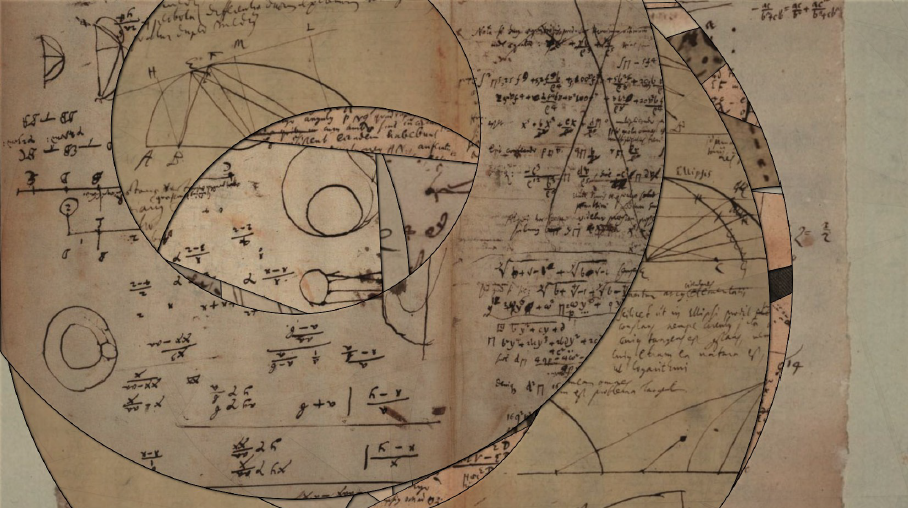
Illustration 1: Image 260 of Letters From Leibniz
Gottfried Wilhelm Leibniz (1646-1716)
Gottfried Wilhelm Leibniz discovered/created linear algebra and calculus. He was a great mathematician. Relatedly, he thought deeply about computing machines and language. He’s an important figure in the history of the computer, symbolic logic, and the philosophy of computation. He's also one of the great philosophers of his age, with Descartes and Spinoza.
Letters From Leibniz 2.0
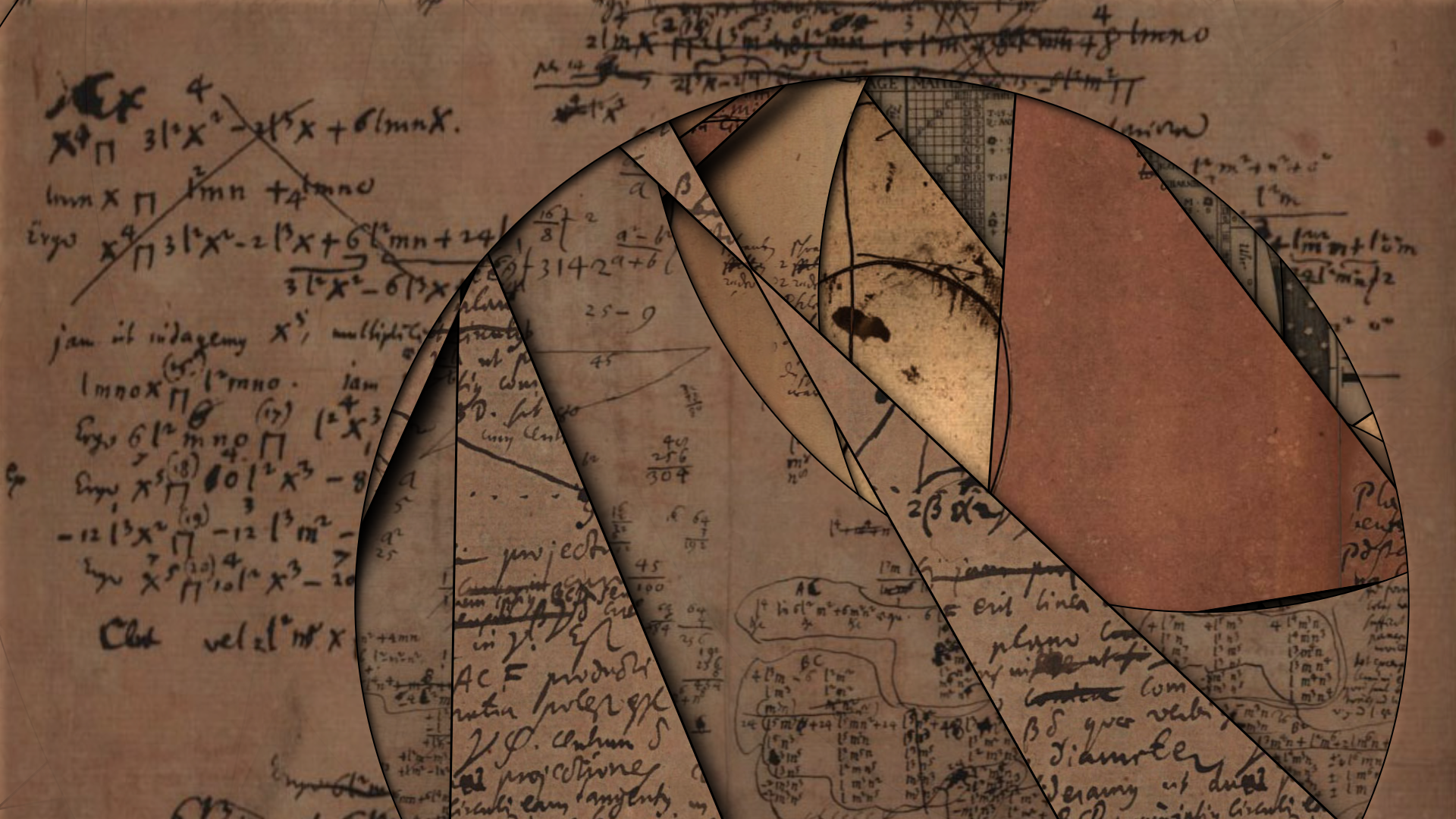
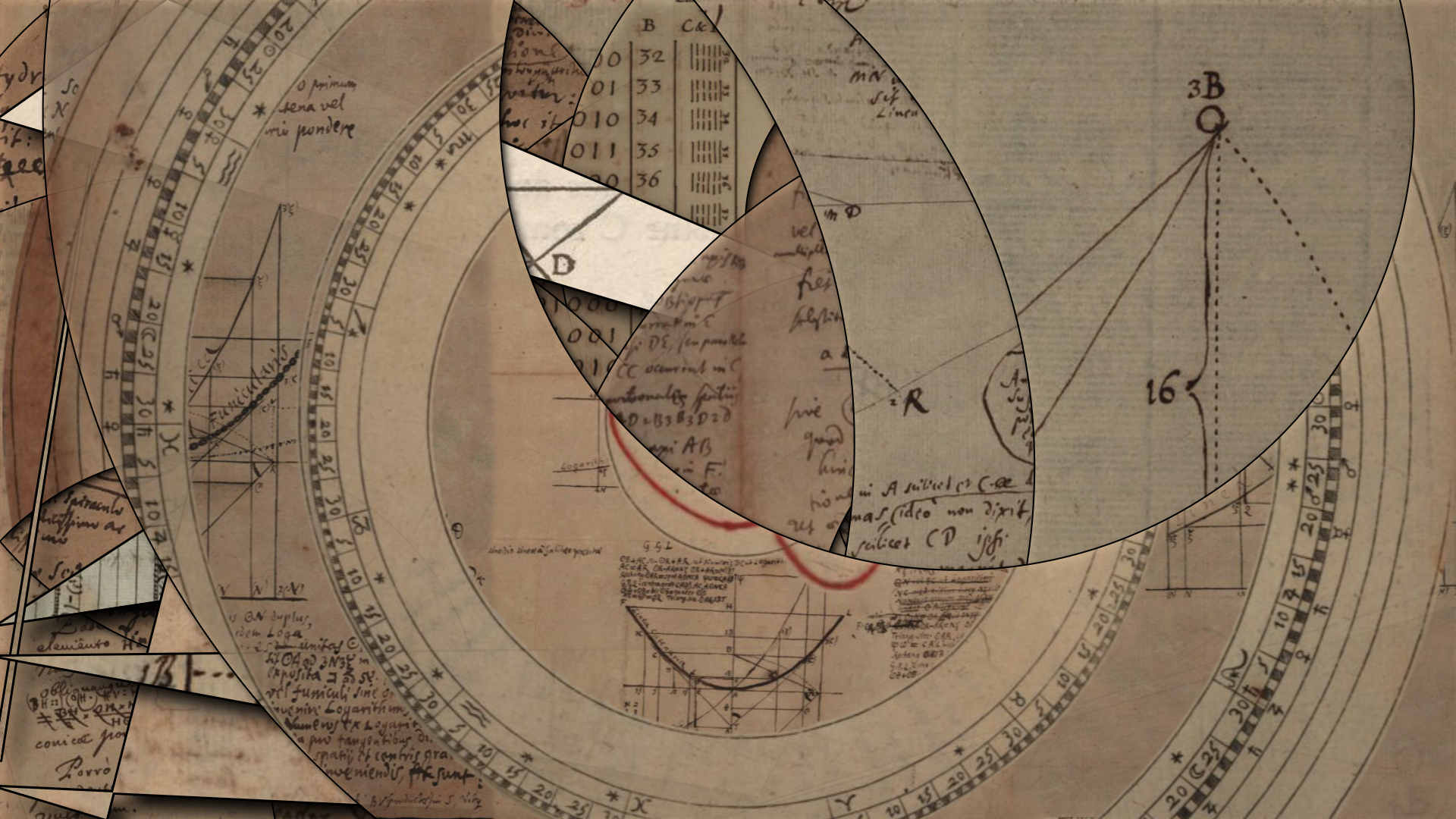
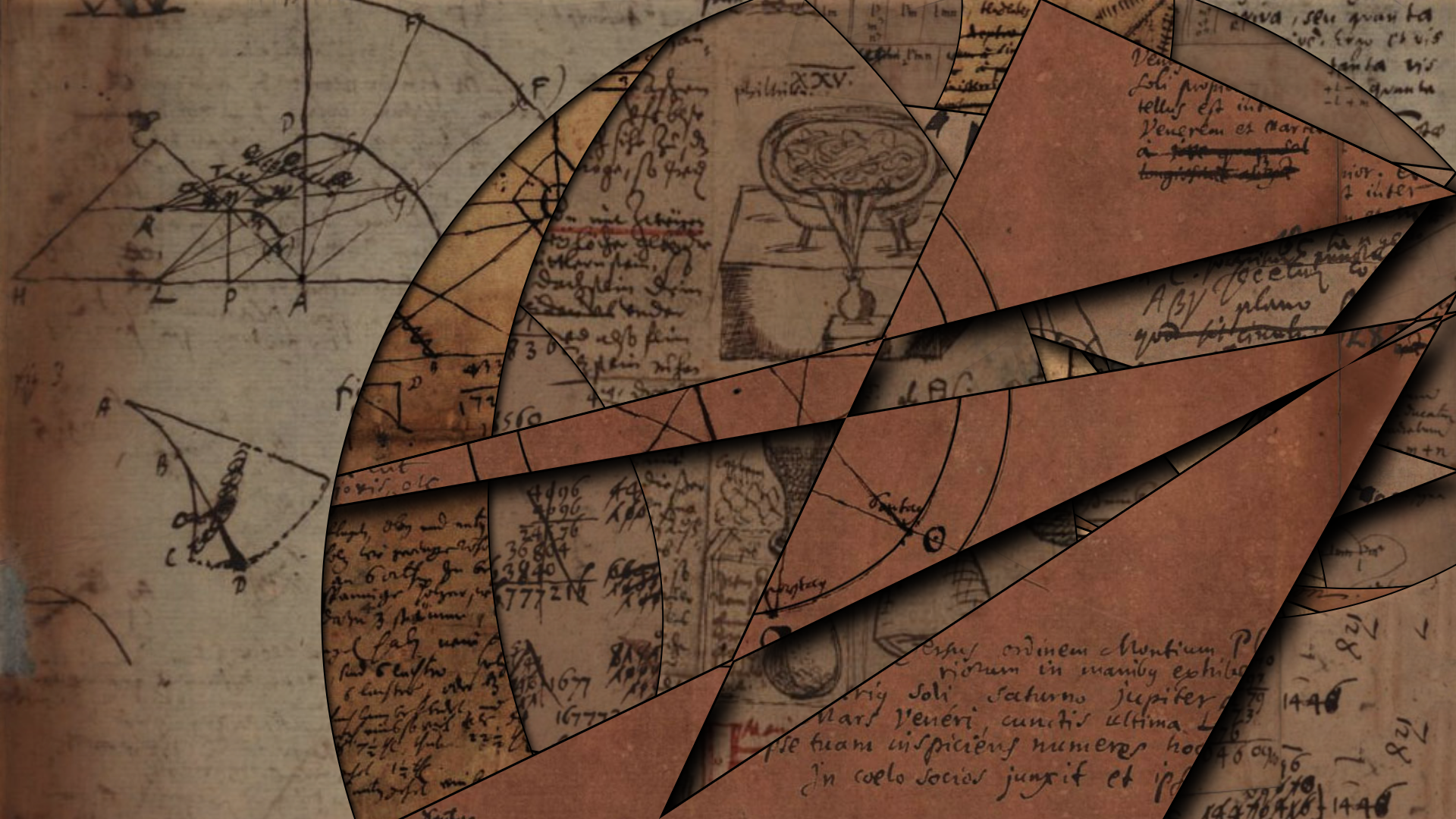
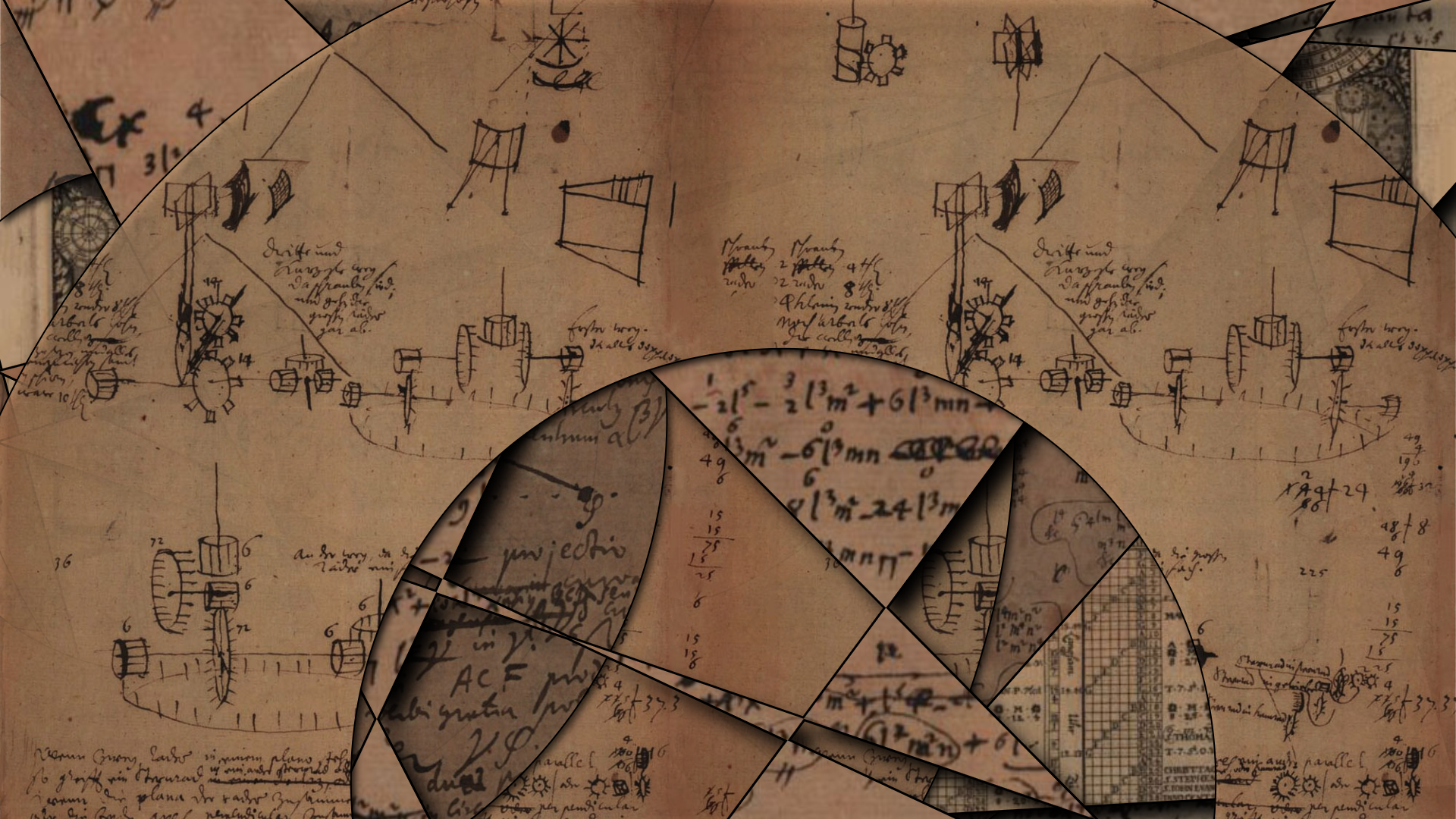
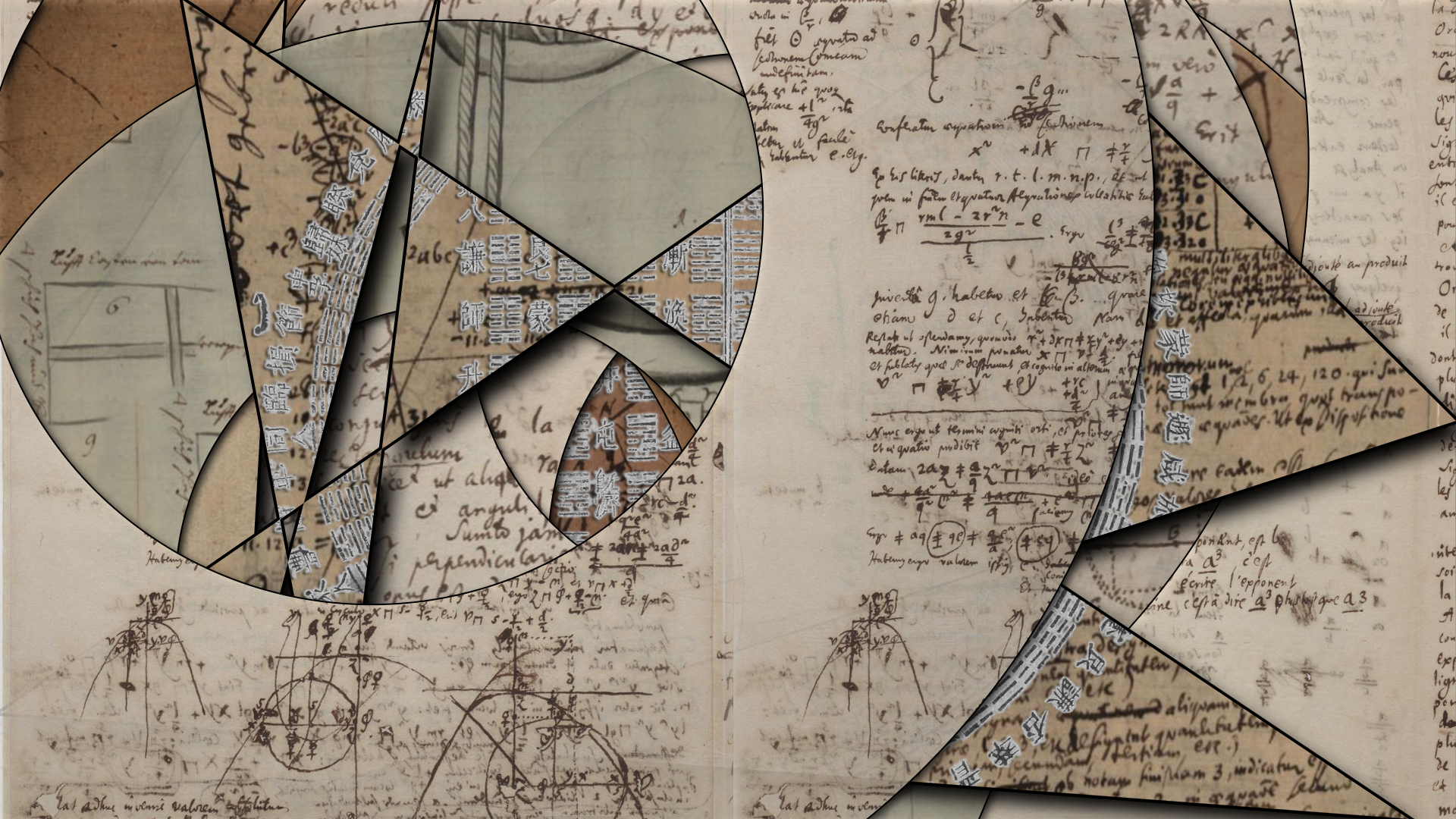
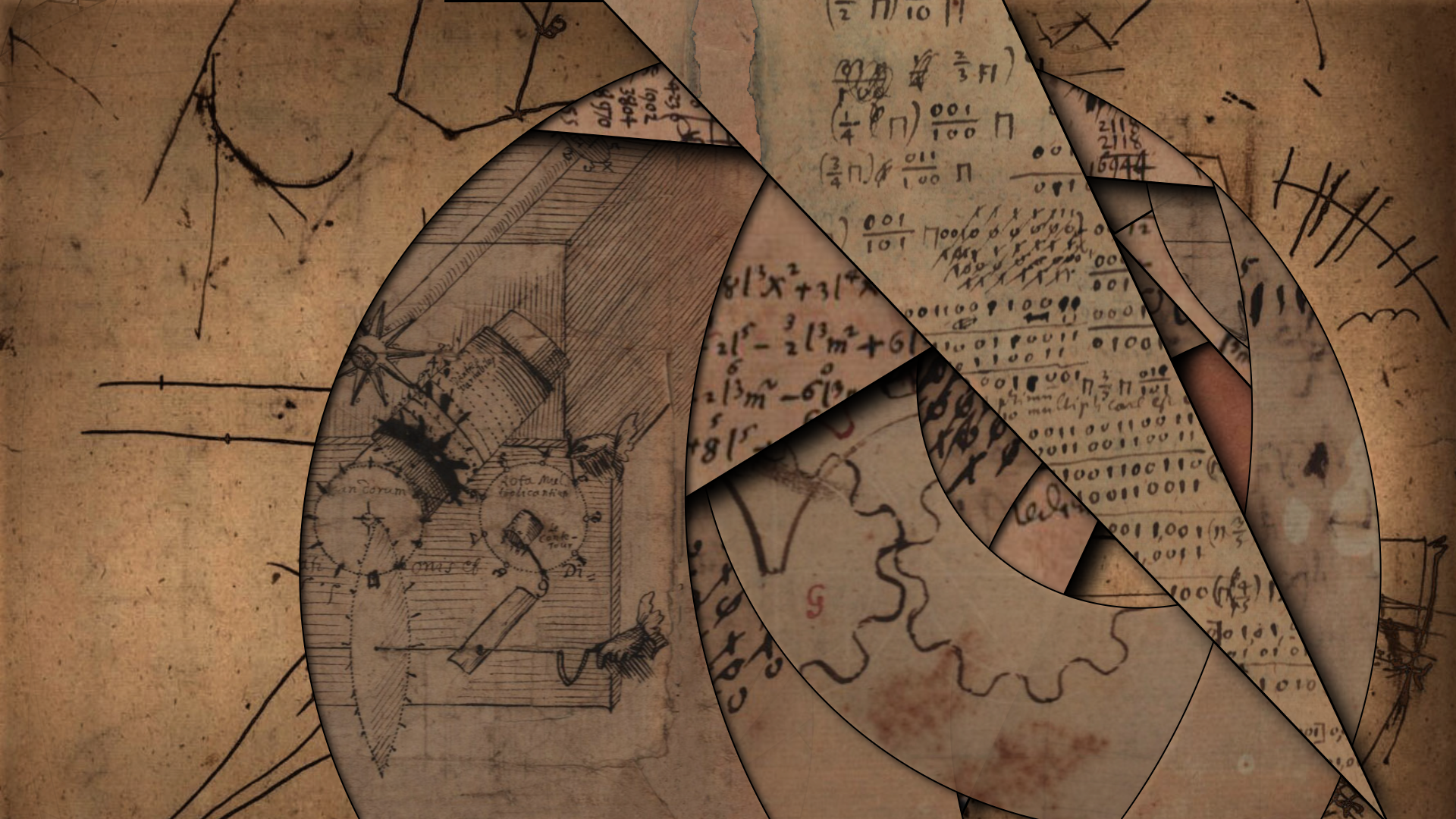
This essay is about Leibniz and Letters From Leibniz 2.0, which is an online slideshow of 500 digital collages I made using Aleph Null, a graphic synthesizer I wrote in JavaScript+HTML+CSS that randomly samples 238 photos of Leibniz’s hand-written manuscripts, correspondence, and other of Leibniz’s graphical belongings. Aleph Null produces a never-exactly-the-same-twice animation that samples Leibniz’s most visually compelling writing.
Leibniz’s subjects range from his binary number system to other bases, through several Leibniz pages on magic cubes and linear algebra, and considerable on curves, tangents, infinite series and infinitesimals (calculus), to geometry problems, to the design of his computational machine, to meditative visual—sometimes full-page—enumerations carried out, perhaps, for later contemplation. 24 of the 238 Leibniz source images deal with binary, ranging from binary arithmetic to the I Ching, to hexagrams in base 3, to the decimal expansion of numbers in base 2—infinite series. Leibniz was a poet of the infinite and infinitesimal.
It’s all mixed into a visual show of 500 images, in Letters From Leibniz, where you see the source images a bit at a time and put them together, with repeated viewings, on your own. Now you see it. Now you don’t. Later on you see different parts again. You put the pages together, mentally. Then you put the writing together at a deeper level, if you can.
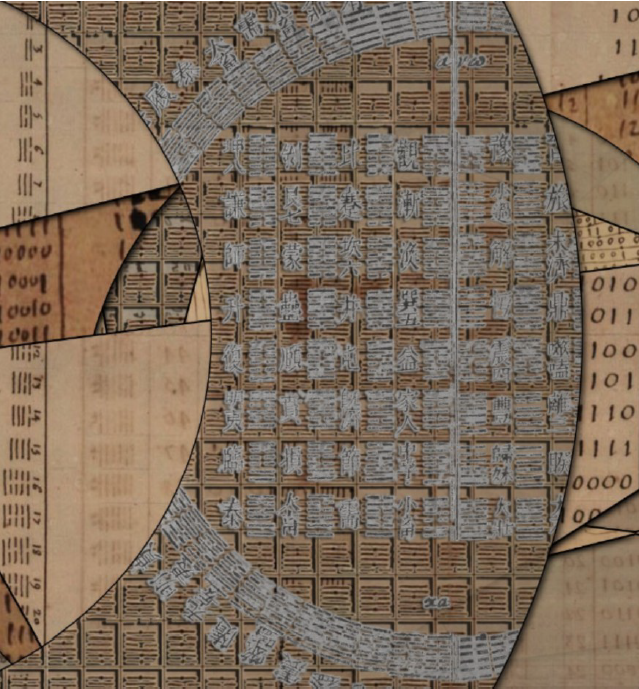
llustration 2: From image 290 of Letters From Leibniz
How many times do we typically see each Leibniz source image? Suppose that the 238 source Leibniz images are sampled randomly among the 500 digital collages, and that, on average, we see 6 source images in one digital collage. Then we make 500×6 = 3000 image selections among the 238 random possibilities. So the expected number of times we see any particular image is 3000/238 ~ 13. We see each image around 13 times. Some more, some less. That’s enough to usually reveal it all at least once.
All is revealed in the 71 minutes it takes for the slidvid to show all 500 digital collages.
Visual Dimensions of Leibniz's Writing
The visual dimensions of Leibniz’s writing are intriguing. Much of his work was never published, during his lifetime, but exists, still, as hand-written/hand drawn manuscripts.It ranges from finished things—that look better hand-drawn than they ever will typeset—to hasty arithmetical calculations not meant to be widely seen. Some of these have strong artistic energy to them. Leibniz’s work usually has the look of something meant to be looked at. Even when it doesn’t, it’s often highly expressive. It goes from polished to punk, from exploratory to contemplative, from writing to illustration, illustration to alchemy, alchemy to analysis.
He wrote in Latin, French and German. And he could write in several different fonts or scripts. Also, his mathematical writings are frequently accompanied with rich illustrative diagrams, often in Cartesian coordinate systems.
His fascination with binary (base 2) and the I Ching is evident in several pages he created of hexagrams. He also did some work in base 3. Illustration 3 is part of a full-page enumeration of all 36 = 729 hexagrams in base 3. Their resemblance to hexagrams from the I Ching is no coincidence, as we shall see.
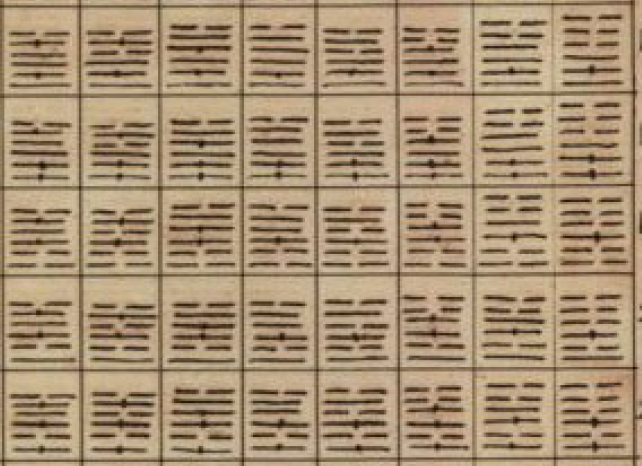
Illustration 3: Hexagrams in trinary (base 3).
From image LH 35,3B,7,[2]-1v in the Gottfried Wilhelm Leibniz Library
Leibniz was the first to write about numbers in base 16 (hexadecimal). This is discussed in a 2022 book called Leibniz on Binary by Lloyd Strickland. It contains several images from the Gottfried Wilhelm Leibniz Library that are also in Letters From Leibniz. Strickland provides English translations of those images, and writes at length about what's going on in each of them.
We see Leibniz’s interest in binary also in a clock he devised that has only one hand, displays binary, and is tactile for the blind, or for the sighted when it needs to be read at night in the dark. The clock was never actually made during Leibniz's lifetime.
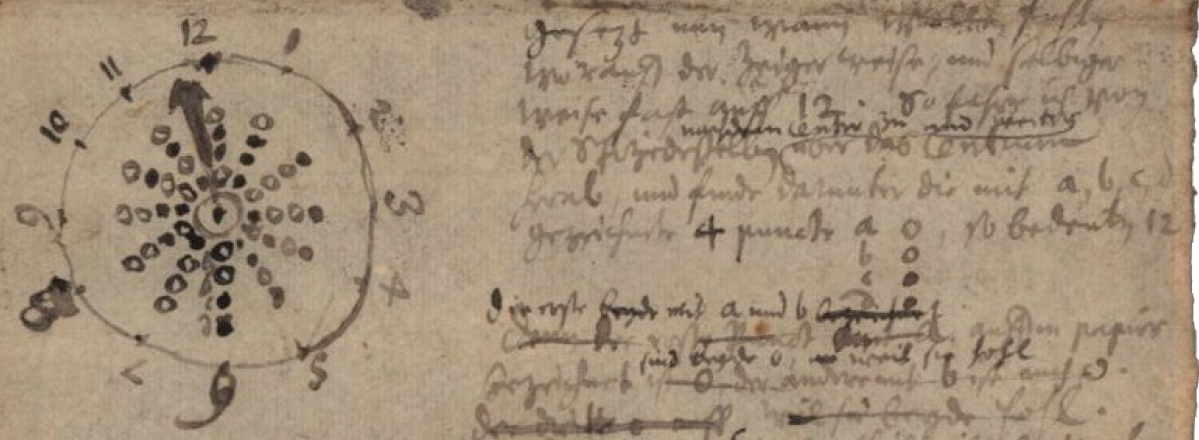
lustration 4: Leibniz's Tactile Binary Clock
From image LBr. 916, [87] 44r in the Gottfried Wilhelm Leibniz Library
Leibniz also wrote extensively about the calculating machine he created, the Stepped Reckoner, and illustrated those writings at length. In Leibniz's diagrams of the Stepped Reckoner, there are lots of interlocking gears. It's useful to think of these in relation to odometers (which are quickly disappearing in favour of digital displays). As we know, odometers have wheels/gears that interlock. There are ten teeth on each wheel of a normal odometer. Cuz odometers are, normally, in base 10. If the number system used is base 4, there will be four teeth on each wheel of the odometer. Thus we see the fundamental relation between gears and numbers in something like a calculator. Gears often represent one digit of a number in an odometer-like construction. Other gears or sub-gears may be for adding, subtracting, multiplying and dividing the numbers.
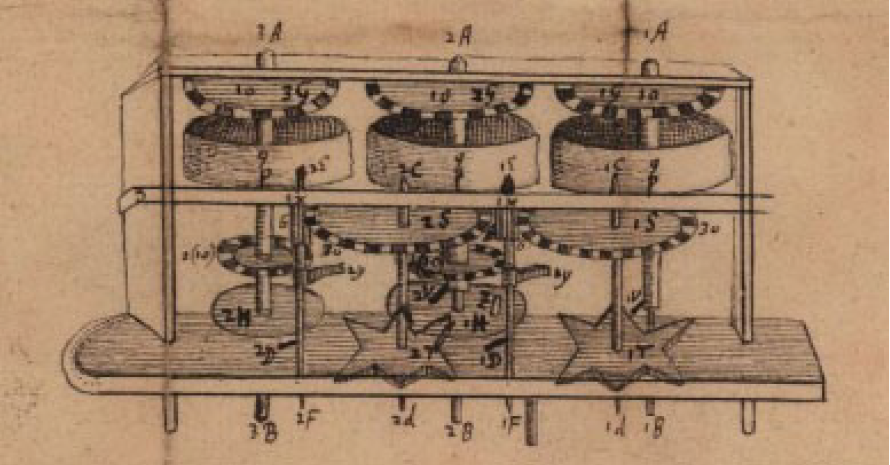
Illustration 5: Parts of the Stepped Reckoner.
From image LH 42,4,1,[17]-9r in the Gottfried Wilhelm Leibniz Library
Other visual dimensions include polynomials not graphed but written in algebraic notations; infinite series of polynomials; his personal calculus notations, including the current integral symbol ∫, and the fractional notation he created for derivatives, i.e. rates of change, in calculus, dy/dx. Also, he drew alchemical/chemical instruments, alchemical symbols, planetary symbols, and zodiac symbols—typically as variables for equations.
Leibniz's motivation for creating calculus was different from Newton's. Newton was fascinated with physics and needed calculus to solve problems of motion. Leibniz was not so involved in physics. He was more interested in the classic dual problems of finding the tangent to a curve and the area under a curve, in contrast to Newton's concern with finding velocities and accelerations etc from physics. And Leibniz was also fascinated with the infinite and the infinitesimal. Mathematically, philosophically and metaphysically. Infinite sequences and series were of great interest to him. I've tried to include lots of images of these issues in his writing.
He also wrote deeply about magic squares and cubes, and illustrated them beautifully with 7 pages of 3D diagrams. These were part of his mathematical investigation of systems of linear equations. He and Descartes are credited as the originators of linear algebra, which is basically matrix math.
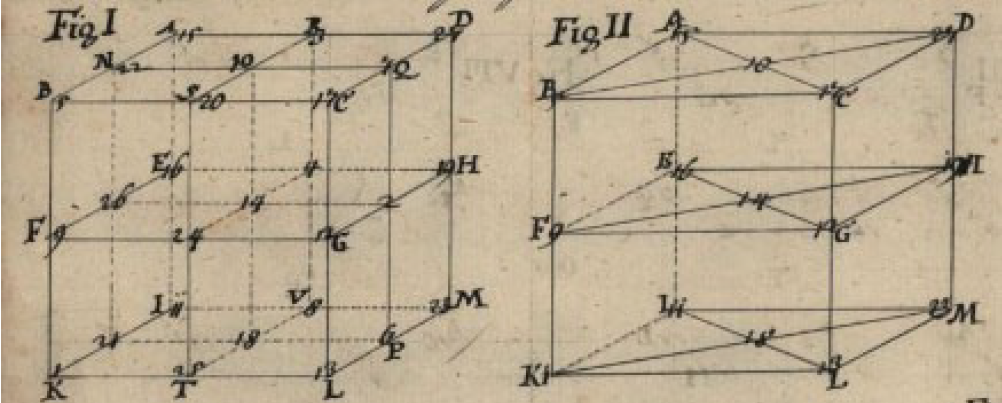
Illustration 6: Magic squares.
From image LH 35,11,5,[15]-8r in the Gottfried Wilhelm Leibniz Library
He also created (or was in the possession of) some interesting concentric, seemingly turnable wheels-within-a-wheel that would have allowed the user possibly to dial into a specific astronomical moment, to see, perhaps, the approximate position of the planets, sun, and/or moon at that moment. Or the level of the tides.
The papers he used were colourful and textural, and have aged to perfection over the course of 300 years. I have mostly left the colour authentic in Letters From Leibniz. I changed it slightly, in some cases, for contrast, so that the language is more readable, and the pages, in total, have more variation in colour. All the slides in Visual Leibniz, on the other hand, retain the authentic colour.
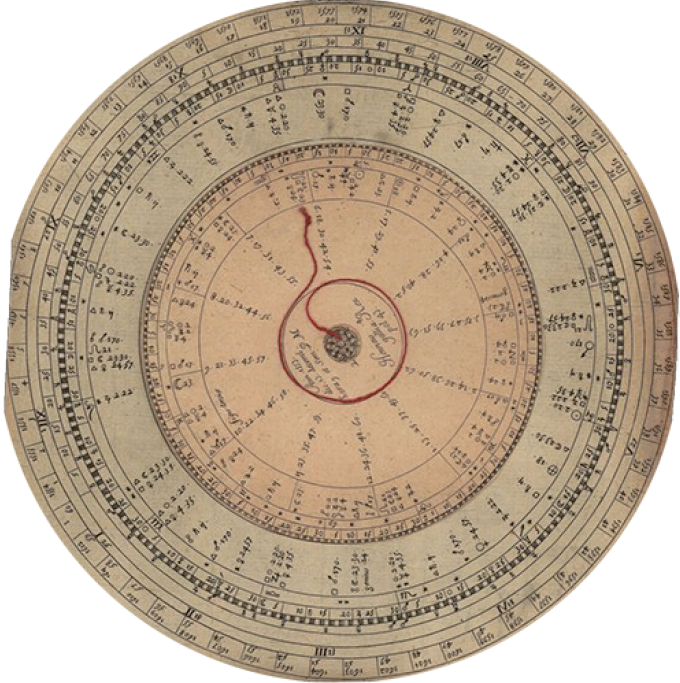
Illustration 7: One of 5 similar constructions.
Image LH,35,15,6,[163]-79br in the Gottfried Wilhelm Leibniz Library
Leibniz was apparently fond of making page-length enumerations. He did that with hexagrams in base two (binary) and base 3. He also enumerated all binary numbers of up to 16 digits long. His enumerations seem to have been for meditation. Perhaps to see patterns in the enumeration, or graphical enumeration as a way to pass the time, like counting sheep. Hard to say why, but he did like to enumerate combinatorial things.