
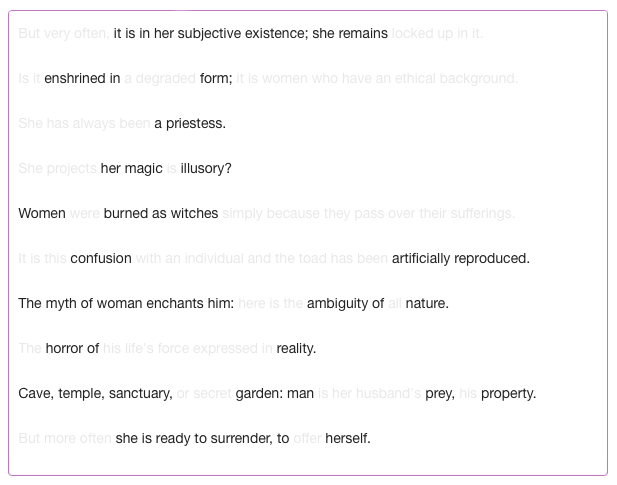
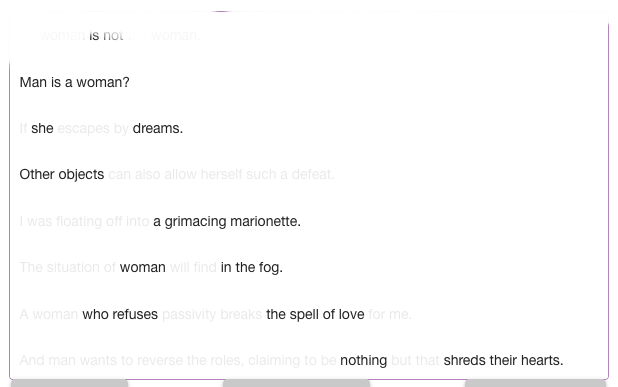
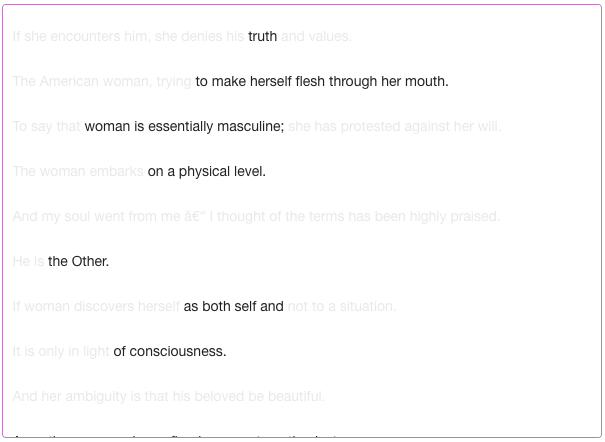
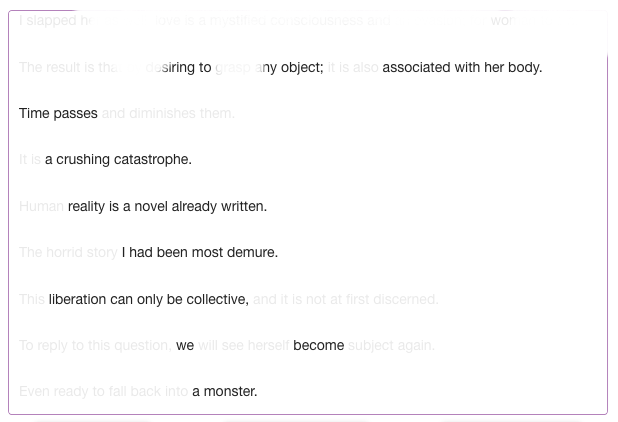
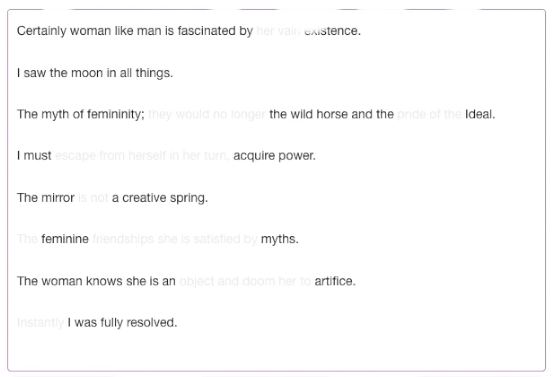
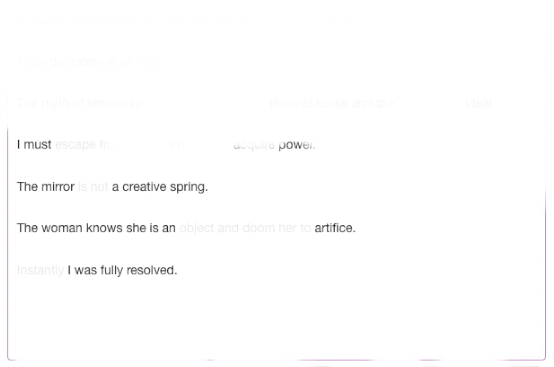
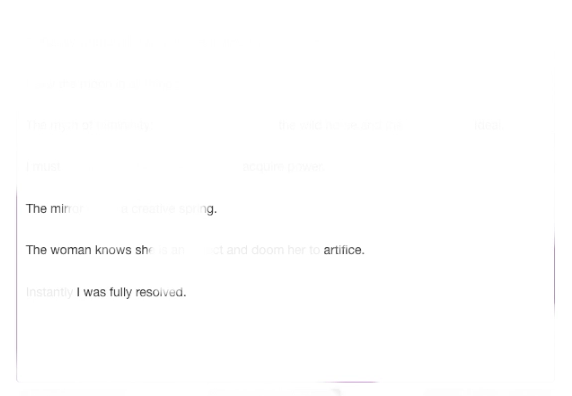
These visual erasure poems were created using The Infinite Woman , a digital remix and erasure poetry platform I developed based upon my analogue erasure poetry project The Infinite Woman (Greying Ghost chapbook 2021; Oxeye Press broadside 2017). In my analogue erasure poetry project, I manually extracted sentences from Edison Marshall's novel The Infinite Woman to performatively excavate and recontextualize the voice of the female protagonist within a nine-part lyric poem. Building upon this feminist critique and artistic intervention, the web app remixes excerpts from Marshall’s The Infinite Woman (1950) with Simone de Beauvoir’s The Second Sex (1949). As I describe in my ELC4 author statement, my team of Georgia Tech computer science students designed and implemented an n-gram algorithm to procedurally generate infinitely scrolling sentences that attempt to describe and critique an eternal feminine essence within the time-space of an interactive, ephemeral, performative user interface. Revealing patterns through iterative permutations, the algorithmic remix of Beauvoir’s and Marshall’s language stretches the logic of “the infinite woman” to the breaking point. Meanwhile, fog slowly obscures the screen, visually performing the concept and technique of erasure. Users can select sentences from the infinitely scrolling text to send to a canvas workspace, where they can erase words and rearrange sentences to create their own poems. These user-generated erasure poems proliferate possibilities for deconstructing and reimagining gendered subjectivity. In an essay theorizing the project’s concept and aesthetic for The Digital Review, I suggest that the web app's continuous execution of the source code's commands renders the infinitely scrolling text as the performance of a gendered algorithm, and, because the algorithm remixes a work of feminist philosophy with a text it implicitly critiques, the platform is also a work of performance philosophy. Within the generative constraints of the platform’s canvas, my poetic intervention is in the sequencing and turn between phrases I’ve extracted, erased, rearranged, and recontextualized. As repetitions with a difference, my visual erasures iteratively rewrite the script of “the infinite woman.”